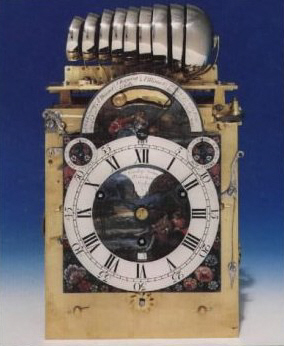
Mechanical devices for playing music have
quite a long history. Composers have written music especially for
instruments such as musical boxes, clockwork organs, and pianolas. In
this section we include compositions by Handel, Haydn and Mozart. The
Mozart work in particular is a mature masterpiece.
Stongly encouraged by Prince Esterhazy, Haydn wrote more than 30 pieces
for Musical Clocks.
Joseph Haydn'sFlötenuhrstücke für
klavier (Nagel, 2nd edition 1954) provides transcriptions for
piano of 32 of them; 30 of these were taken from three Musical Clocks
(dating from 1772, 1792 and 1793) which still survive, the other two
from a manuscript. There is also a very interesting commentary by the
editor, Ernst Fritz Schmid; this includes details of which pieces were
specially composed for this purpose and which were arranged from other
sources. The Handel pieces come from a manuscript in the Royal Music
Librry in which they are described as Tunes for Clay's
Musical Clock. They were transcribed by Bridget Fry and Fritz
Spiegl and published by Schott in 1955.
Of course one disadvantage of mechanical instruments is that the
performance can sound mechanical! For example the simplest machines do
not provide for any variation in the volume of sound; and similarly the
rhythmic pulse is often completely invariable, giving a remorseless
"sewing-machine" effect. Ingenious methods evolved for overcoming these
shortcomings; for example by the beginning of the 20th Century Duo-Art
piano rolls were able to reproduce quite subtle variations of rythm and
volume, so that piano rolls made by pianists of the time such as
Paderewski give a real improession of what their playing sounded like -
certainly better than the flat scratchy sound recordings of the time.
Computers provide really good answers to the problems of mechanical
music-making. One can create and control musical sounds by writing a
MIDI file, but the process is complicated and too inhibiting for most
musicians to create really musical performances. The SIBELIUS file is
much more friendly since you can write directly in familiar musical
notation, and use familar expression marks to humanise the performance.
| Home | Composers | Full list of music | Special Collections | Latest additions | Using this site | About us | Links |
| Composer | Work | Movements | Notes |
|---|---|---|---|
| Beethoven | Allegro in C for Musical Clock | (3 flutes) | |
| Handel | Pieces for Clay's Musical Clock | 01 A Voluntary on a Flight of Angels | |
| 02 Sonata | |||
| 03 Allegro | |||
| 04 Gigue | |||
| 05 Minuet | |||
| 06 Allegro moderat | |||
| 07 Air | |||
| 08 Gigue | |||
| Haydn | These 12 Pieces were composed for a Musical Clock which was made in 1792 |
01 Allegro | |
| 02 Allegretto | |||
| 03 Presto | |||
| 04 Andante | |||
| 05 Minuet | |||
| 06 Minuet | |||
| 07 Allegretto | |||
| 08 Minuet | |||
| 09 Allegro | |||
| 10 Vivace | |||
| 11 Minuet | |||
| 12 Presto | |||
| These 12 Pieces were composed for a Musical Clock which was made in 1793 |
01 Allegretto | ||
| 02 Andante | |||
| 03 Vivace | |||
| 04 Minuet | |||
| 05 Allegro ma non troppo | |||
| 06 Fugue | |||
| 07 March | |||
| 08 Andante | |||
| 09 Allegretto | |||
| 10 Allegro | |||
| 11 Minuet | |||
| 12 Presto | |||
| Mozart | Andante for Musical Clock | K616 |
Comments are welcome. Please write to williamww@aol.com Last modified: 13 July 2009. |